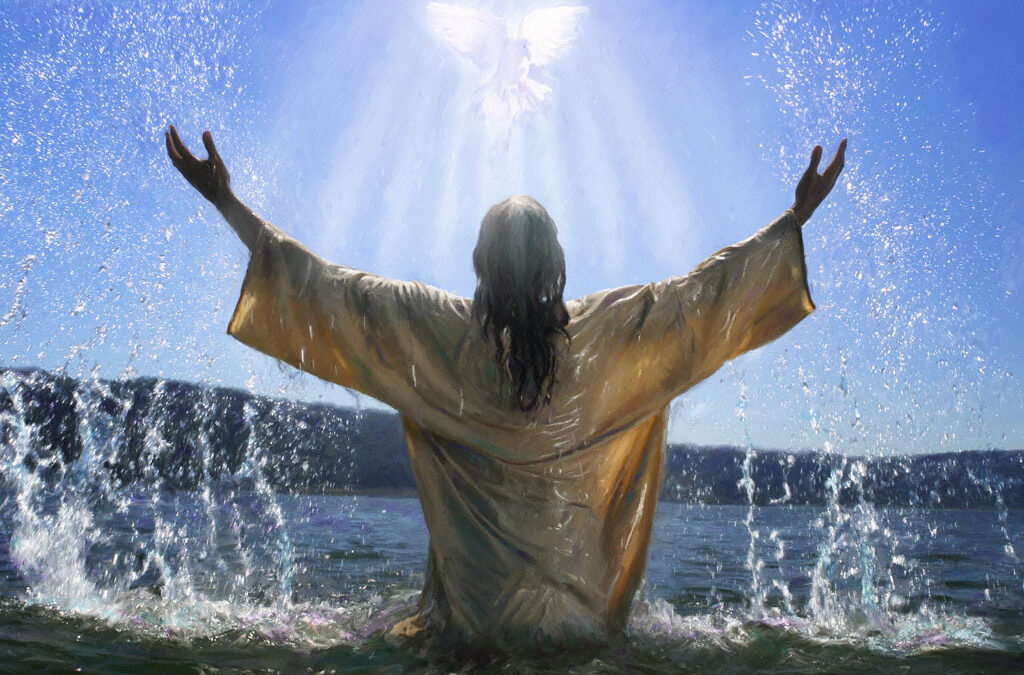
Funny things sometimes happen in church, especially surrounding special ceremonies like baptism. When I baptize young people or adults, I usually like to use a lot of water because it is supposed to be a visible sign of invisible grace. I remember one time when I was baptizing a group of four siblings. When I came to the youngest, whose name was Ryan (meaning “little king”), he had already seen how much water I could hold in my hand and pour over the heads of his brothers and sister. Therefore, when I scooped a big handful of water out of the baptismal font and poured it on his head, he quickly moved his tie to one side so that it would not get wet as the water descended. He was smiling as he did this, and it brought a big smile to everyone in the congregation. Baptisms are joyous times.
I think Jesus’ baptism also must have been a joyous time. Let us see what Mark has to say about it in Mark 1:9-13….
In those days Jesus came from Nazareth of Galilee and was baptized by John in the Jordan. And just as he was coming up out of the water, he saw the heavens torn apart and the Spirit descending like a dove on him. And a voice came from heaven, “You are my Son, the Beloved; with you I am well pleased.”
And the Spirit immediately drove him out into the wilderness. He was in the wilderness forty days, tempted by Satan; and he was with the wild beasts; and the angels waited on him.
This story raises a big question: if John’s was a baptism of repentance for forgiveness of sin, why did Jesus go to John to be baptized? After all, the Bible teaches us that Jesus was without sin. (Hebrews 4:15)
I think part of the answer is that Jesus was baptized to identify with us. Matthew and Luke would want to point out to us that Jesus identified with us from the moment of his birth: thus, the inclusion of the birth narratives in their Gospels. But Mark wants to emphasize that Jesus identified with us as sinners right at the beginning of his ministry, in his baptism by John.
Now, the next step is very important. Not only did Jesus identify with us through his baptism, but also through our baptism, we identify with Jesus. Baptism is part of how we get connected to Christ and benefit from his life, death and resurrection.
Now, here is the truly great news…. If we have identified with Jesus, if we are in Christ, then everything that Mark says of Jesus in this passage will, I believe, be true of us….
First, if we identify with Jesus in baptism then I believe God will be doing unexpected things in our lives. Nothing could have been more unexpected to the Jews of Jesus’ day than that the Messiah would come from Nazareth in Galilee. Remember what Nathaniel says in John’s Gospel: “Nazareth? Can anything good come from there?” (John 1:46) It was not that Nazareth was a particularly bad place. It is just that there was no mention of Nazareth in connection with the Messiah in the Hebrew Scriptures. Thus, God was doing something unexpected by having Jesus, the Messiah, come from there.
I wonder: given that we serve the God of wonderful surprises, what unexpected, good thing might God want to do in your life and in mine?
A second thing we see in this passage is that if we identify with Jesus in baptism, there will be times when we will see the heavens torn apart. Now, let me explain what I mean by this. When Mark says that Jesus saw the heavens torn apart, I do not think it means that there was literally a hole up in the sky and that Jesus saw through that hole into God’s heaven. Notice, that Mark says Jesus saw this. He does not mention anyone else seeing this. It was a personal revelation to Jesus. “The heavens being torn open” was, for Mark, a traditional way of expressing revelation.
Therefore, if we are in Christ I think that at times we will have similar personal revelations. We will have times where we will be more supremely aware of the “God dimension” in our living. I believe that the veil between our earthly existence and God’s heavenly abode is very thin, perhaps thinner in certain times and places than others. However, the key thing is that if we are still, we will know that God is God (Psalm 46:10); we will be aware of his presence.
Third, if we are in Christ then the Spirit will descend upon us like a dove. Throughout the New Testament, baptism and the impartation of the Holy Spirit are connected (Acts 2:38; 1 Corinthians 12:13; Titus 3:5). The interesting thing to me in this passage is that the Holy Spirit descended upon Jesus like a dove. I imagine that John the Baptist expected something much more violent. However, here the Spirit comes on Jesus in a gentle and peaceful manner. I think that is most often the way with us as well. I do not believe that the Holy Spirit is usually manifested in a violent manner, but in a peaceful, gentle, quiet way.
Fourth, if we identify with Christ then we will hear the voice of our heavenly Father, telling us that he loves us. Jesus heard this voice audibly. It may happen that way with us, but it may happen in other ways as well. Again, I think when we get quiet, when we seek the still, small voice, we will hear God telling us that he loves us. When we read Scripture, we read the message that God loves us. I am here today to tell you that God loves you. You are loved by the Father.
Tom Wright has this to say about this passage…
A famous moviemaker had a huge legal wrangle with his long-time mentor and guide. The younger man simply couldn’t handle criticism and ended up rejecting the person who had helped him so much. When it was all over, a close friend summed up the real problem. ‘It was all about an ungenerous father,’ he explained, ‘and a son looking for affirmation and love.’
It happens all the time, in families, businesses, all over. Many children grow up in our world who have never had a father say to them (either in words, in looks, or in hugs), ‘You are my dear child’, let alone, ‘I’m pleased with you.’ In the Western world, even those fathers who think this in their hearts are often too tongue-tied or embarrassed to tell their children how delighted they are with them. Many, alas, go by the completely opposite route: angry voices, bitter rejection, the slamming of doors.
The whole Christian gospel could be summed up in this point: that when the living God looks at us, at every baptized and believing Christian, he says to us what he said to Jesus on that day. He sees us, not as we are in ourselves, but as we are in Jesus Christ. It sometimes seems impossible, especially to people who have never had this kind of support from their earthly parents, but it’s true: God looks at us, and says, ‘You are my dear, dear child; I’m delighted with you’ Try reading that sentence slowly, with your own name at the start, and reflect quietly on God saying that to you, both at your baptism and every day since.
This leads to a fifth point. If we identify with Jesus, then our lives will be pleasing to the Father. Not only does he love us for who we are in Christ, God will be pleased with our actions, our accomplishments, because the Holy Spirit working through us will produce the fruit that is pleasing to the Father: love, joy, peace, patience, kindness, goodness, faithfulness, gentleness, and self-control.
Some of us may feel like we could never please our earthly fathers. However, that will not be the case with our heavenly Father. Our lives will please him; our lives do please him in Christ.
Sixth, if we have identified with Jesus in baptism then the Spirit will drive us into the wilderness for our forty days.
Here is where the story begins to have an edge to it. Everything seems very positive up to this point: John the Baptist preaching in the wilderness preparing the way for the Lord, Jesus being baptized, the Father confirming his love for his Son. All is good.
So why would the Spirit drive Jesus out into the wilderness, the same Spirit who just descended on Jesus in the form of a gentle, peaceful dove? Perhaps the answer lies in the fact that, as we saw with John the Baptist, there are some lessons we can only learn in the wilderness of loneliness. It is only when we have all our normal resources stripped from us that we realize just how all-sufficient God truly is.
The wilderness, the desert, was a place of temptation, a place of testing, for Jesus. If we have identified with Jesus, then Satan, the adversary, will tempt us; there will be opposition. You cannot choose the way of Jesus and not face some push back.
I suppose some people have a hard time believing that there is such a person as Satan, the adversary. Personally, I have no such problem. It seems obvious to me that there is such a thing as evil in the world. I also believe in a supernatural realm, so why should there not be evil on that level as well? I agree with what C. S. Lewis had to say about this….
There are two equal and opposite errors into which our race can fall about the devils. One is to disbelieve in their existence. The other is to believe, and to feel an excessive and unhealthy interest in them. They themselves are equally pleased by both errors and hail a materialist or a magician with the same delight.
So, I believe in the existence of the devil. However, the good news in all of this is that if we identify ourselves with Jesus then he will also equip us, through the Spirit, with strength to overcome the adversary.
Amidst the testing in the wilderness, we get an interesting picture that is only in the Gospel of Mark. We read that Jesus was “with the wild beasts”. Now this can be a threatening picture if we imagine it one way, but there is an alternative way of looking at this cryptic phrase. I think here we have a picture of Jesus as the Second Adam, in harmony with all creation, just as the first Adam was in harmony with all creation before the fall when he named all the animals.
Just so, if we identify with Jesus then we too will find harmony with all of God’s creation. This may not happen at first, but I believe we should be working toward it. Paul gives us a vision of God renewing all creation in Romans 8.
Because this is where we are heading, toward the renewal of all creation with ourselves in harmony with all God has made, therefore we should not act as though it does not matter what we do with our bodies. We should not act as though it does not matter how we treat God’s creation. It does matter. We need to be good stewards of all that God has made, good custodians of this world that God has entrusted to our care….
This passage ends with some very good news. If we identify ourselves with Jesus, then we will have the help of the angels. Throughout Scripture, we see the angels assisting God’s children. How much more will the angels assist us if we are in Christ? People talk about having a guardian angel. However, I do not see in Scripture where we are limited to the assistance of one angel per person. I believe that God will do whatever it takes to assist his children, whether that means dispatching one angel or a legion of angels to help us in our time of need.
The following story is told about a Christian minister in Iran….
As the minister was driving with his wife, they stopped in a small Iranian village to purchase some water. Before entering, the minister noticed a man holding a machine gun and leaning against the wall outside the store. The minister’s wife looked at the man’s face and the gun, then put a Bible in her husband’s hand and said, “Give that man this Bible.” Her husband looked at the man—his menacing beard and his machine gun—and replied, “I don’t think so.” But she persisted: “I’m serious. Give it to him. Please, give him the Bible.”
Trying to avoid the issue, the husband said, “Okay, I’ll pray about it.” He went into the shop, purchased the water, climbed back into the car, and started to drive away. His wife looked at him and said, “I guess you didn’t give him the Bible, did you?” Looking straight ahead, he replied, “No, I prayed about it and it wasn’t the right thing to do.” She quietly said, “You should have given him the Bible,” and then she bowed her head and started praying. At that point, he turned around and told his wife, “Fine! If you want me to die, I will.”
When the minister returned to the store, the man with the machine gun was still standing against the wall. The minister approached him and placed the Bible in his hand. When the man opened it and saw it was a Bible, he started to cry. “I don’t live here,” he said. “I had to walk for three days in order to get to this village. But three days ago an angel appeared to me and told me to walk to this village and wait until someone had given me the Book of Life. Thank you for giving me this book.”
I believe in angels. I believe they are around us all the time. They are here to assist us. They are messengers of God for our good. If we identify with Jesus, then we will have the assistance of the angels. We will experience harmony with God’s creation. We will know deliverance from temptation. We will know the all-sufficiency of God in the wilderness places of life. We will live lives pleasing to God. We will experience God’s love. We will have the Holy Spirit. We will receive revelation, and God will do unexpected, glorious things for us. The only question is: have we identified with the One who identified himself with us?
Comments