A June 2012 article in The New York Times online apparently struck a nerve for many people. The article received over 800 comments and was often quoted and retweeted. The following quote captures the essence of the author’s analysis of what he calls “the busy trap.”
If you live in America in the 21st century, you’ve probably had to listen to a lot of people tell you how busy they are. It’s become the default response when you ask anyone how they’re doing: “Busy!” “So busy.” “Crazy busy.” It is, pretty obviously, a boast disguised as a complaint. And the stock response is a kind of congratulation: “That’s a good problem to have,” or “Better than the opposite.”
Busyness serves as a kind of … hedge against emptiness; obviously your life cannot possibly be silly or trivial or meaningless if you are so busy, completely booked, in demand every hour of the day… [We’re] busy because of [our] own ambition or drive or anxiety, because [we’re] addicted to busyness and dread what [we] might have to face in its absence.
Jesus was a busy person too. When you put together last week’s text with the one that we are about to read this morning, you get a snapshot of one 24-hour period in Jesus’ life. During that one day, Jesus taught in the synagogue, cast an unclean spirit out of a man in that same synagogue service, healed Simon’s mother-in-law, healed and cast out demons for the entire town of Capernaum, and then, presumably, went to bed very late. That is where our text for this morning picks up. Listen for God’s Word for you from Mark 1:35-39…
In the morning, while it was still very dark, he got up and went out to a deserted place, and there he prayed. And Simon and his companions hunted for him. When they found him, they said to him, “Everyone is searching for you.” He answered, “Let us go on to the neighboring towns, so that I may proclaim the message there also; for that is what I came out to do.” And he went throughout Galilee, proclaiming the message in their synagogues and casting out demons.
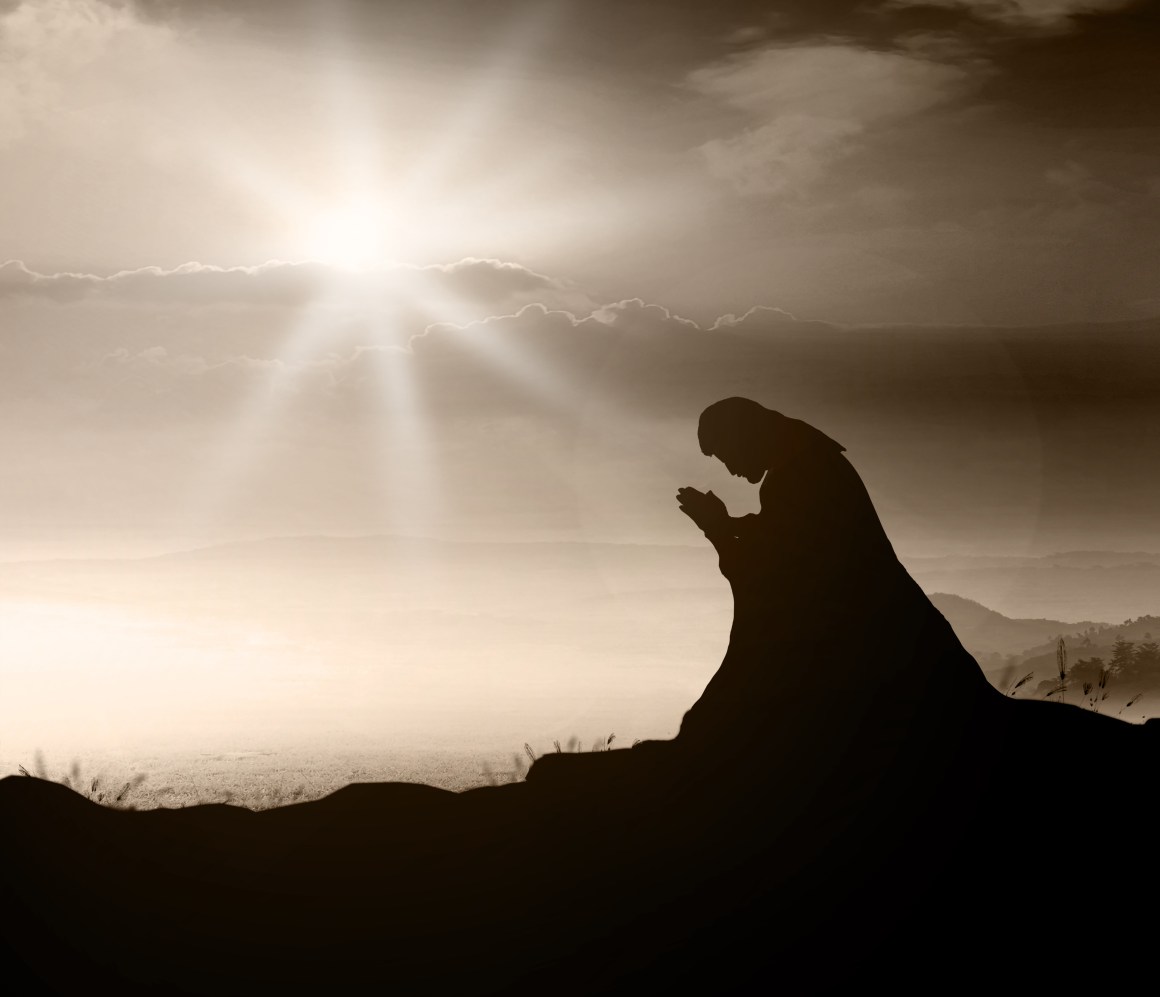
Jesus was obviously a very busy man, but he was not addicted to busyness. I believe that one way he got free of this addiction was through prayer. Let us look together at what Jesus did, step by step.
First, he got up early. Apparently, Jesus spent the night at Simon’s house. In that house we have Simon, his mother-in-law, perhaps Simon’s wife, Andrew, James, John, and Jesus. The house was, no doubt, not very big. The only way Jesus could spend some time alone in prayer was to get up early when everyone else was asleep.
We do not know if Jesus got up early every day to pray. The Bible does not tell us. Furthermore, the Bible does not command us: “Thou shalt get up every morning at 5 o’clock to pray.”
However, it is interesting to me that we read of others in the Bible who rose early in the morning to meet the Lord. In Genesis 28:18, we read that Jacob rose early to worship the Lord. Moses rose early and built an altar to God (Exodus 24:4). On another occasion, Moses rose early to meet God on Mount Sinai (Exodus 34:4). Gideon rose early to talk with the Lord (Judges 6:38). Elkanah and Hannah rose early to worship the Lord (1 Samuel 1:19). Job got up early to offer sacrifices to the Lord (Job 1:15). David said in Psalm 5:3, “In the morning, O Lord, you hear my voice; in the morning I lay my requests before you and wait in expectation.”
Down through church history, the people of God have risen early for prayer. Martin Luther remarked that when he knew he was going to have a particularly busy day he would get up even earlier and pray longer. D. L. Moody said, “We ought to see the face of God every morning before we see the face of man.”
Dawson Trotman, the founder of the Navigators ministry, got up every morning and prayed from 5 to 7 with a friend, before he went to work at his construction job. Daws and his friend began by praying for their boys’ Sunday school class. They ended up praying for many places around the globe. Today, the Navigators has a ministry in all those countries for which Daws and his friend prayed.
When I was in seminary, there was a group of Korean students who got up early every morning to pray. How do I know? I know because they prayed below my dormitory room and often woke me up, unintentionally. I know that the activity of pious prayer warriors can be irritating to those of us who do not feel we have that gift.
Maybe you are not an early morning person. Maybe you are a night owl and that is the best time for you to set aside a special time to pray. Or maybe it works best for you to take a few minutes during lunch at work or at home. I do not know. However, I do know that we will not have a set aside time for prayer unless we make it a priority.
So that is the first thing we see about Jesus in this passage: Jesus made prayer a priority by getting up early to pray. The second thing we see is also important: Jesus went to a solitary place.
Jesus had to leave the house where he was staying to find a solitary place to pray. If you try to pray where there are many distractions—other people, television, or radio then you will probably have difficulty focusing. Jesus went to a place where he could focus, and he tells us to do the same.
In Matthew 6:6 Jesus says, “But when you pray, go into your room, close the door and pray to your Father, who is unseen. Then your Father who sees what is done in secret, will reward you.”
I believe that in our time and culture we need to have time alone with God more than ever because of the hectic pace of our society and the voices that are constantly bombarding us.
The July 2011 issue of Real Simple magazine offered the following statistics and observations about the proliferation of noise and the lack of silence in our world:
- In 1920, a Nebraska inventor designed the first automobile alarm. In 2004, New Yorkers proposed a bill to ban car alarms as a public nuisance.
- Between 1975 and 2010 the average number of TV sets per household rose by 87 percent (from 1.57 TV sets per household to 2.93).
- Out of the approximately 111.8 million households accounted for in the U.S. Census Bureau’s 2009 American Housing Survey, about 25.4 million (nearly 25 percent) report being bothered by street noise or heavy traffic.
- In a 2006 Pew Research Center poll, 82 percent of respondents said they had encountered annoying cell phone chatter in public. (Amazingly, only 8 percent of the respondents felt that their cell phone habits were irritating to others.)
The article quotes George Prochnik, author of In Search of Silence, who said, “I think we’re seeing noise tied to a host of problems of the age—problems of attention, aggression, insomnia, and general stress. Noise is now the default position as a society. But I believe we have to make an effort to build a passionate case for silence.”
At a church denominational headquarters, it was customary for all employees to pause for prayer each morning at 9 o’clock. A “prayer bell” signaled the beginning and ending of this daily routine. Occasionally, though, employees would find themselves on the phone during prayer time, and the entire office, now quiet, would overhear the conversation.
One morning during prayer time, a man could be heard in his office shouting: “Hello? Hello? I can hear you. Can you hear me?”
After the ending bell, someone else in the office commented, “I think Paul is having a hard time getting through to the Lord this morning.”
Perhaps we all have a hard time “getting through to the Lord” because we do not remove distractions from our life. We each need solitary places where we can be alone with the Lord in prayer.
A third thing we see Jesus do in this passage is simply pray. Sometimes the best way to make prayer a priority is simply to make a start. Like the old Nike commercial said, “Just do it!”
We are not told what Jesus prayed on this occasion. The important thing is that he communicated with his Father in heaven.
For four years, I received spiritual direction from a Catholic priest, Father Mario Claro. I realized very early on in our acquaintance that Father Mario meant something different when he used the phrase “prayer life” than what I meant. When he used that phrase, I thought of the time I was trying to set aside every day, to talk to God and to hear from God through reading Scripture. However, I soon learned that what Father Mario meant by “prayer life” was really the whole of my life. He emphasized the importance of what Paul calls “praying without ceasing” (1 Thessalonians 5:17), of simply having a running conversation with God throughout the day.
If we are going to have that kind of prayer life, we probably need to start by having a set aside time to pray in a solitary place just as Jesus did. Some of you may feel like saying to me: “Well, how do I pray on my own? I do not even know how to go about it.”
The resource I use now for my daily prayers is called “Pray as You Go”. You can get it as an app on your phone, and you can pray while you are in the car, or exercising, or wherever you are on the “go”. “Pray as You Go” provides a guided time of prayer, with music, Scripture, and pertinent questions to think about.
Whatever resource or plan you use for prayer, the key is to find what works for you and then do it. As someone once said, “It is not the plan that works, but the plan you work that works.”
A final thing we see Jesus doing in this passage is going and serving.
When people came looking for Jesus he did not say, “Don’t bother me; I’m praying!” No, he got up and went with the disciples and served throughout Galilee in preaching and healing people because that was his purpose in coming to earth in the first place. On another occasion Jesus said, “For the Son of Man did not come to be served, but to serve, and to give his life as a ransom for many.” (Mark 10:45)
Prayer was never meant to be our only priority in life. A set-aside time of solitary prayer to the Lord is best when it acts as a springboard to service and conversational prayer throughout the day.
The Lord talks about many other priorities we need to have in life. Some of them, like prayer, are “big rocks” too. (Stephen Covey used to say, “Big rocks go in first.” In other words, the biggest priorities in your day need to happen first.) Work, family, church, loving people to Jesus, all these things are important priorities in life. I believe that the Lord wants to revitalize us through prayer so that we can go through our day with strength and power and joy from him to meet every challenge.
However, sometimes it takes the Lord intervening in our lives, stopping us in our tracks, to get us to see our need for spending time alone with him in prayer. In Leadership magazine, a friend of our family named Ben Patterson, a former pastor, tells this story….
In the spring of 1980, I was suffering great pain from what was diagnosed as two herniated discs in my lower back. The prescription was total bed rest. But since my bed was too soft, the treatment ended up being total floor rest. I was frustrated and humiliated. I couldn’t preach, I couldn’t lead meetings, I couldn’t call on new prospects for the church. I couldn’t do anything but pray.
Not that I immediately grasped that last fact. It took two weeks for me to get so bored that I finally asked my wife for the church directory so I could at least do something, even if it was only pray for the people of my congregation. Note: it wasn’t piety but boredom and frustration that drove me to pray. But pray I did, every day for every person in my church, two or three hours a day. After a while, the time became sweet.
Toward the end of my convalescence, anticipating my return to work, I prayed, “Lord, this has been good, this praying. It’s too bad I don’t have time to do this when I’m working.”
And God spoke to me, very clearly. He said, “Stupid (that’s right, that was his very word. He said it in a kind tone of voice, though.) You have the same twenty-four hours each day when you’re weak as when you’re strong. The only difference is that when you’re strong you think you’re in charge. When you’re weak you know you aren’t.”
Sometimes it takes a special intervention of God for us to realize how weak we are all the time, and how dependent we are on him, and how much we need to pray. The good news is that Jesus is praying for us weak people right now. In Hebrews 7:25 we read that Jesus “is able for all time to save those who approach God through him, since he always lives to make intercession for them.” I believe that means Jesus is praying for you and for me right now.
As if that was not good enough news, Jesus also gives us his Holy Spirit to help us pray, to pray in us and through us. In Romans 8:26-27 Paul says, “Likewise the Spirit helps us in our weakness; for we do not know how to pray as we ought, but that very Spirit intercedes with sighs too deep for words. And God, who searches the heart, knows what is the mind of the Spirit, because the Spirit intercedes for the saints according to the will of God.”
Thus, we have Jesus praying for us in heaven right now, and we have the Spirit praying in us and through us, when we do not even know how to pray. What more could we ask for? What greater incentive to pray could there be?
Comments