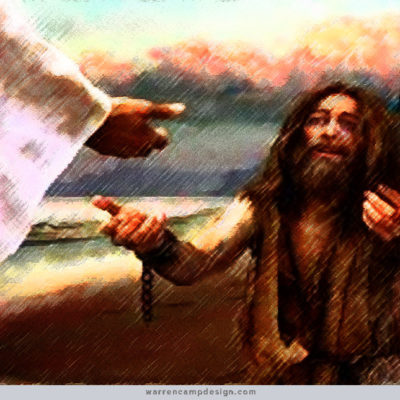
Listen for God’s word to you from Mark 5:1-20…
They went across the lake to the region of the Gerasenes. When Jesus got out of the boat, a man with an impure spirit came from the tombs to meet him. This man lived in the tombs, and no one could bind him anymore, not even with a chain. For he had often been chained hand and foot, but he tore the chains apart and broke the irons on his feet. No one was strong enough to subdue him. Night and day among the tombs and in the hills, he would cry out and cut himself with stones.
When he saw Jesus from a distance, he ran and fell on his knees in front of him. He shouted at the top of his voice, “What do you want with me, Jesus, Son of the Most High God? In God’s name don’t torture me!” For Jesus had said to him, “Come out of this man, you impure spirit!”
Then Jesus asked him, “What is your name?”
“My name is Legion,” he replied, “for we are many.” And he begged Jesus again and again not to send them out of the area.
A large herd of pigs was feeding on the nearby hillside. The demons begged Jesus, “Send us among the pigs; allow us to go into them.” He gave them permission, and the impure spirits came out and went into the pigs. The herd, about two thousand in number, rushed down the steep bank into the lake and were drowned.
Those tending the pigs ran off and reported this in the town and countryside, and the people went out to see what had happened. When they came to Jesus, they saw the man who had been possessed by the legion of demons, sitting there, dressed and in his right mind; and they were afraid. Those who had seen it told the people what had happened to the demon-possessed man—and told about the pigs as well. Then the people began to plead with Jesus to leave their region.
As Jesus was getting into the boat, the man who had been demon-possessed begged to go with him. Jesus did not let him, but said, “Go home to your own people and tell them how much the Lord has done for you, and how he has had mercy on you.” So the man went away and began to tell in the Decapolishow much Jesus had done for him. And all the people were amazed.
Why did Jesus cross the Sea?
C. S. Lewis wrote in Mere Christianity, “When Christ died, He died for you individually just as much as if you had been the only man in the world.”
Augustine said, “God loves each of us as if there were only one of us to love.”
Jesus cares about the “demons” you must deal with in your life, and he will cross the sea or do whatever it takes to intervene in your life and bring healing to you.
Furthermore, Jesus does not see only your demons. Jack Crowley has written…
All too often we identify someone with their demons. As soon as we do so, we see only the things that they do wrong. We become blind to the person and, more importantly, we forget that that person is sick and hurt and probably crying out for help. These cries may take the form of self-destruction, isolation, and instability, all symptoms of a greater illness that needs healing.
Thank God Jesus does not see only our demons. He sees who we can become by his grace. And he will cross any barrier to reach us and heal us.
The man from Gerasa had what Mark calls “an unclean spirit”. Mark gives a vivid description of the havoc this unclean spirit had wreaked in this man’s life. Here he was, unable to even live in human society any longer. He was living among the tombs. This man was howling like an animal and hurting himself with stones. The man was so strong, and so violent, that no one could control him anymore, even by binding him with chains.Some people question whether demons and demon possession are real. Some suggest that what the New Testament describes is merely some kind of psychological disorder. I do not think so for at least two reasons.
First, psychiatrist M. Scott Peck notes in his book, People of the Lie, that as he was going about his work he came across people whose problems required an entirely different level of help beyond normal psychiatric care. Peck came to believe in the reality of the demonic and recorded case histories in his book.
Second, I have encountered demon possession, or at least demon oppression, personally. The Bible talks about it. It is a demonstrable spiritual phenomenon beyond any of our usual psychological categories of mental illness, and I have seen it first-hand.
C. S. Lewis once wrote in The Screwtape Letters…
There are two equal and opposite errors into which our race can fall about the devils. One is to disbelieve in their existence. The other is to believe, and to feel an excessive and unhealthy interest in them. They themselves are equally pleased by both errors and hail a materialist or a magician with the same delight.[1]The good news is that Jesus has power over demonic oppression and possession.
It is interesting to me that the man from Gerasa was drawn to Jesus. He ran and bowed down before him. Yet, at the same time, the demon or demons within this man begged Jesus not to torment them. Apparently, Jesus had already commanded the demons to come out of the man.
This shows us that exorcism is no easy process. The demons did not come out of this man the first time Jesus addressed them. If Jesus had this experience in trying to exorcise demons, how much more will we? In many situations it takes multiple attempts, many prayers, before Satan and his demons are overcome.
In ancient times, it was thought that if you knew the name of something, that gave you power over it. Thus, Jesus asks for the name of the demon and the demon says his name is Legion.
A Roman legion was a basic military unit consisting of up to 5,400 men. Thus, if the demons are not lying, this man had many demons in his life. Yet, Jesus is not overpowered by this great army of evil.
The demons beg Jesus not to send them out of the country but rather into a herd of pigs grazing nearby. Jesus gives them permission for this, and the demons cause the pigs to rush over the nearby cliff and to be drowned in the water below. This reminds me of Jesus’ statement in John 10:10, “The thief comes only to steal and kill and destroy. I came that they may have life and have it abundantly.”
Satan may promise great things, but we must remember that he is a liar and the father of lies. All that Satan and his demons want to do is steal, kill, and destroy. That is exactly what they do here to the herd of pigs.
While it is sad that this herd of animals should have to die, the story perhaps suggests that one human soul is more important to Jesus than thousands of pigs. We must also remember that this story takes place in Gentile territory. So, it is not surprising that there are pigs there. And since Jews were not allowed to eat pig meat, the first-century Jews who heard this story probably cared very little, if at all, about what happened to the pigs.
However, people from the local area did care about what happened. The swineherds went off and told the story in the city and in the country. The result was that many people came to see for themselves. We read that when they “saw the demoniac sitting there, clothed and in his right mind, the very man who had had the legion… they were afraid.”
Now, if this was awe in response to Jesus’ divine act, then that would have been alright. However, these people asked Jesus to leave their area. What is going on here?
William Barclay explains…
A man had been healed but their pigs had been destroyed, and therefore they wanted no more of this. The routine of life had been unsettled, and they wanted the disturbing element removed as quickly as possible.Barclay goes on to delineate the things people don’t want disturbed: comfort, possessions, religion, and beliefs. People don’t want unpleasant subjects to disturb the decorum of their religion. It is fine and dandy to learn about theology, but once that theology demands that we care for the poor, or refugees, or feed the hungry, or become missionaries, we want none of it.
A frequent battle-cry of the human mind is, “Please don’t disturb me.” On the whole, the one thing people want is to be let alone.
Some people do not want personal relationships to disturb their religion. They love having quiet time alone to meditate, but they do not want to be disturbed by having to care for other people in any practical way.
Others do not want their beliefs disturbed. Perhaps they have inherited those beliefs from their parents, and they do not want to endure the hard, mental labor of thinking through what they should believe for themselves.
The people of Gerasa may not have wanted any of this, but they especially did not want their economy disturbed. Anyone destroying their livestock needed to be driven from the area. The same is often true of people today. Once Jesus demands something that affects their wallets, they want nothing to do with him.
However, that was not the attitude of the man who was freed from his demons. He wanted to follow Jesus wherever he was going next.
Jesus’ response is both poignant and unexpected. It was poignant because it was probably the last thing this man wanted to hear. He wanted to cling to the man who had saved his life.
However, as hard as it was to hear, Jesus had good news for this man. Jesus had a mission for him. That mission was to go home to his friends and tell them how much the Lord had done for him and what mercy he had experienced. Therefore, the man went away and began to proclaim in the Decapolis how much Jesus had done for him, and everyone who heard his story was amazed.
“Decapolis” means “ten cities”. These ten cities were Greek in character and population. They were located on the eastern side of the Sea of Galilee in modern-day Jordan. In fact, my son James studied Arabic in Jordan one summer and visited Gerasa, or what is now known as Jerash. William Barclay says, “They were beautiful cities; they had their Greek gods and their Greek temples and their Greek amphitheaters; they were devoted to the Greek way of life.”
In this story we have a foretaste of Jesus’ later command to his disciples to…
Go, therefore and make disciples of all nations, baptizing them in the name of the Father and of the Son and of the Holy Spirit, and teaching them to obey everything that I have commanded you. And remember, I am with you always, to the end of the age. (Matthew 28:19-20)
To see how important these ten cities were we only need to remember some of the famous Greeks who came from there…
- Philodemus, the great Epicurean philosopher who was a contemporary of Cicero,
- Meleager, the master of the Greek epigram,
- Menippus, the famous satirist, and
- Theodorus, the rhetorician, who was the tutor of Tiberius, the reigning Roman Emperor.
Perhaps, now we can glimpse why Jesus sent this healed man back to his own people. This man was to be a personal witness for the positive power of Jesus Christ among the Greeks. As Barclay says, he was to be a living, walking, vivid, unanswerable demonstration of what Jesus can do for a person. We should never glory in what we can do for Jesus, but in what he can do for us, in us, and through us. As Irenaeus once said, “The glory of God is man fully alive.”
Christianity was destined to overtake both Greek and Roman civilization, and in this one corner of the empire, it all began with this one man who had been healed by Jesus. I believe that Jesus always begins with the individual. And so, in our own time and place, why should that individual not be you, or me?
[1] Lewis, C. S. The Screwtape Letters (p. ix). Kindle Edition.
Comments